Your AI Agents Have Tools. Do Your Auditors Know Which Controls They Touch?
AI agents are only as dangerous as the tools you hand it. More and more, those tools arrive through the Model Context Protocol (MCP): a few lines of JSON in a config file that give an agent your filesystem, your GitHub account, or your production database.
Developers are adding MCP servers to Claude, Cursor, and VS Code faster than governance can keep up. I've spent nearly 20 years in technology, risk and compliance and have had the pleasure of working on everything from Army RMF packages to enterprise NIST CSF programs, and I've seen this in emerging tech throughout my career. A new capability arrives, adoption outruns oversight, and the auditor's first question usually goes unanswered: which control covers this?
So I built something to help in answering it. It's called mcp-crosswalk, and it's open source.
October had some big new stories for this
For most of this year, MCP risk was mostly hypothetical. This month it wasn't. Here's what happened, and where each incident lands in the crosswalk:
Incident | OWASP MCP risk | Controls the crosswalk points to |
|---|---|---|
CloudSEK documented a ransomware affiliate who registered a reverse shell as a tool in an AI coding assistant and ran live operations through it | MCP09 Shadow MCP Servers | CM-7(5), CM-8(3), ID.AM-02 |
Langflow CVE-2026-105740 (CVSS 9.9): adding an MCP server with the stdio transport gave any authenticated user code execution | MCP05 Command Injection & Execution | CM-7, CM-7(6), SC-39 |
OpenCode: a malicious or hijacked MCP server could run code on a developer's Windows or WSL machine during sign-in | MCP07 Insufficient Authentication & Authorization | IA-9, AC-3, PR.AA-03 |
CVE-2026-116684 in the official MCP Python SDK and CVE-2026-115413 in AWS API MCP Server: tokens issued for one service accepted by another | MCP07 Insufficient Authentication & Authorization | IA-2, AC-3, PR.AA-03 |
None of these are exotic. They're unapproved components, over-privileged launchers, and authentication that checks the wrong thing. Auditors already have controls for all of them. What they don't have is the link from an MCP finding to those controls.
The gap
The security community has moved fast. OWASP published an MCP Top 10 (still in beta), covering risks from token exposure to tool poisoning to shadow servers. Open-source scanners already flag many of those risks and tag them with OWASP IDs.
What's missing is translation. A scanner tells an engineer "plaintext token in config, MCP01." A GRC analyst needs to know what that means for IA-5, whether it belongs on a POA&M, and where it lands in a CSF 2.0 profile. Today that mapping happens in someone's head, one finding at a time, and two analysts rarely make it the same way.
I searched in early October and again on October 31, 2026, and found no public mapping from the OWASP MCP Top 10 to NIST SP 800-53 Rev 5 or CSF 2.0. The closest work maps in other directions. Microsoft's Agent Governance Toolkit maps each MCP risk to its own product components. Equixly maps the NSA's MCP guidance to the OWASP list. security-framework-mcp ties the MCP Top 10 to CWEs. Other projects map MCP risks to the AI RMF, ISO 42001, or SOC 2. None connect them to the catalogs most federal and enterprise programs are built on.
What mcp-crosswalk does
It has three parts.
- The crosswalk. 77 mappings from the ten OWASP MCP risks to 800-53 Rev 5 controls and CSF 2.0 subcategories. Each one has a relationship type, a confidence level, and a written rationale. It's versioned YAML under CC BY 4.0, validated against NIST's own OSCAL catalogs, with baseline membership and derived 800-171 Rev 3 links shown alongside.
mcpxw enrich. If your MCP scanner already writes SARIF and tags findings with OWASP MCP IDs,enrichadds the mapped controls to every finding. You keep your scanner. You just gain the control layer.mcpxw scan. A small reference scanner that reads MCP client config files offline and flags eleven risky patterns. It never starts, installs, or connects to a server, and it redacts any secret it finds.
Here's what that looks like. Instead of "a token is in a config file," a finding reads:
MCPXW-001: Literal secret in server environment variables. Relevant to IA-5(7) and IA-5 (high confidence), SC-28 (low), PR.AA-01 (high), and PR.DS-01 (low).
That's a sentence an auditor can work with. One caveat matters: findings are indicators relevant to controls, not a compliance determination. The tool never says a control is met or unmet.
What I changed when I reviewed it
I reviewed all 77 mappings before publishing. I changed five, lowered the confidence on two, and rewrote the rule for reading every one of them. The test I kept using was simple: picture two circles, one for the risk and one for the control.
- Does the risk include anything the control doesn't cover?
- Does the control cover anything that has nothing to do with this risk?
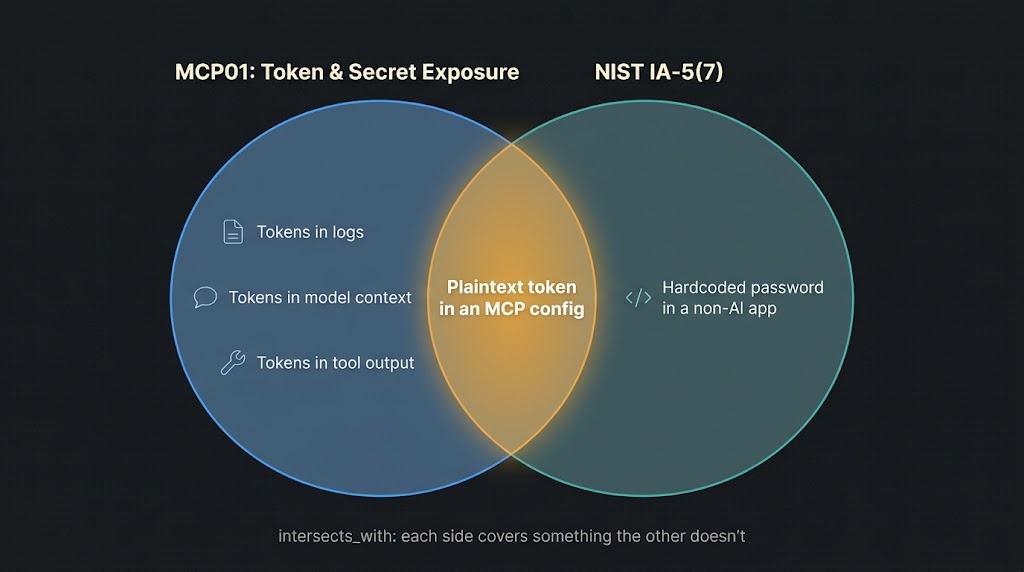
IA-5(7) is the best example. It says not to embed unencrypted static authenticators in applications or static storage. The first draft called MCP01 a subset of it, which sounds right at first. But MCP01 also covers tokens leaking through logs, tool output, and the model's context, which IA-5(7) doesn't touch. And IA-5(7) covers a hardcoded password in a Java app that has nothing to do with MCP. Both circles stick out past each other. That's a partial overlap, so I changed it to intersects_with. Three other mappings failed the same test.
SC-28 got demoted. Protection of information at rest is usually met with full-disk encryption. BitLocker protects a token when the laptop is off or stolen. While you're logged in and working, any process running as you can read that config file, including the MCP servers themselves. The overlap is real but narrow, so confidence dropped from medium to low. The real fix for a plaintext token is getting it out of the file and into a credential store, which is IA-5(7)'s job.
The direction needed a rule. The draft read every relationship as "the control compared to the risk." NIST's OLIR program reads them the other way: the focal element (the MCP risk) compared to the reference element (the control). I rewrote the methodology to follow OLIR, which flipped the one mapping where direction mattered. SR-3 now reads correctly: the MCP supply chain risk sits entirely inside SR-3's scope.
After review, 76 of 77 mappings are intersects_with. That's not vagueness. Most NIST controls cover far more than MCP, and most MCP risks have exposure paths no single control reaches. The methodology says so, and the notes behind every decision are published in the repo.
How it was built
I'll be upfront, as I always am: Claude Code wrote the code, the tests, and the first draft of the mappings. I wrote the specifications, set the guardrails, and reviewed the result. Just like the other tools I created I want to be transparent, because it's the same governance problem this project is about.
So I ran the build the way I'd want any autonomous agent run:
- A sandbox with read-only mounts for the specs and deny rules for credentials and dotfiles
- A written decision log and blocker log, so every judgment call the agent made is on the record
- Quality gates for lint, strict type checks, tests with branch coverage, schema validation, and a dependency audit
- Independent reviews by a separate agent after each release, which caught real problems, including a secret-redaction bug
- My own verification, where I re-ran every gate instead of trusting the agent's completion report
When I later reorganized the repo, the agent couldn't move the protected spec files, so it stopped and handed the step back to me instead of working around the restriction. That's the behavior I like to see. I've seen too many of those posts about Claude deleting production environments.
The result is 679 tests at about 99% branch coverage, with CI on Python 3.11, 3.12, and 3.13. The full build log, including the specs and every logged decision, is in docs/build-log/.
What it can't do yet, and how to try it
A config file only shows so much. The scanner can't assess tool poisoning, prompt injection, or audit logging (MCP03, MCP06, and MCP08), because those only show up in server responses and runtime behavior. Every report says so explicitly. The crosswalk still maps all ten risks, and enrich works with any scanner that can see more.
The source material is still moving, too. The OWASP list is in beta, and MCP06 is in the middle of a rename: the overview now calls it Intent Flow Subversion, while the detailed section still says Prompt Injection via Contextual Payloads. The ID didn't change, so nothing breaks, and the crosswalk has a migration path for when OWASP finalizes its list. On the NIST side, the SP 800-53 overlay project for AI systems was renamed COSIS on October 20, and its agent overlays still have no published draft. Until they do, practitioners need a bridge.
The mappings are also one practitioner's judgment. I'd rather have them challenged than trusted. If you think a mapping is wrong, open an issue and tell me which circle sticks out. I'd love to see what other people are seeing and simply learn a new way to look at something.
Next on the roadmap:
- FedRAMP Rev 5 baseline membership next to the NIST baselines
- An export in NIST's OLIR format, so the crosswalk can be submitted for the official catalog
- An OSCAL Assessment Results export
To try it, you need uv:
git clone https://github.com/mrBenL/mcp-crosswalk.git && cd mcp-crosswalk
uv sync
uv run mcpxw crosswalk show --risk MCP01
The repo is at github.com/mrBenL/mcp-crosswalk. If you run it against your own MCP configs, I'd like to hear what it finds and what it misses.